I expect most of you know what a traditional Enzo was. If you looked under the 1964 250 GTO you’d find a spaceframe chassis, doublebone front suspension, live rear axle and a later development of the ‘Colombo’ V12 that powered the first car, but now doubled to 3-litres.
Interestingly, the second series of the Ferrari model, the 166, appeared in 1948, its 2-litre displacement coming courtesy of a 58.8mm bore – the same bore you would find in the final 275 GTB/4 produced 20 years later.
It was from the same engine family that produced the 4.4-litre that powered the Daytona, and, as they were enlarged, continued the 4.8-litre configuration under the bonnet of the 412 Grand Tourer until 1989, more than 40 years since its conception. Enzo always knew how to bring out the best in whatever he dealt with, be it engineers or racing drivers.
But I’m exaggerating a bit. Because actually, that 125S wasn’t the first Ferrari at all, just the first car to be called a Ferrari, something subtle but clearly different. Nor was it the first car to have the famous galloping horse logo on its sides as that was seen on sports cars and Grand Prix cars when Ferrari ran the Alfa-Romeo racing team in the 1930s.
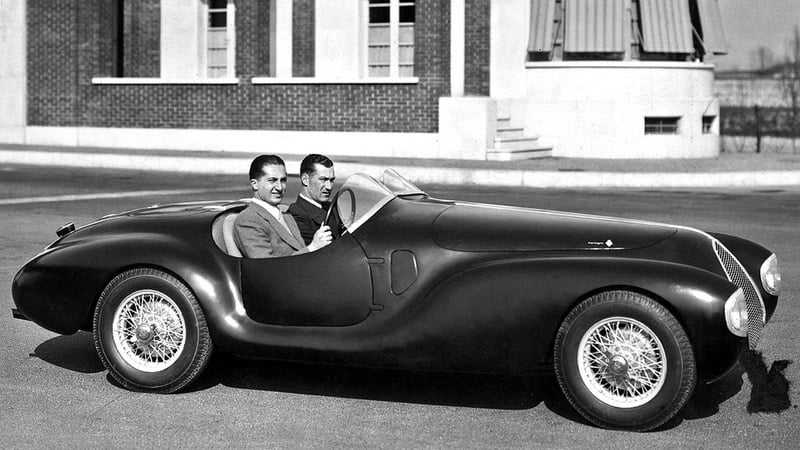
The missing link between the two great eras of Enzo Ferrari was the AAC 815. It was waiting Cars Avio Costruzioni and he was called that not because the great man was too modest to use his own but because the condition for his escape from his Alfa contract in 1938 was that he did not put his name on the car for four years. And in 1942 Enzo and Alfa had other things on their minds.
The 815 was far from a perfect car. Two were built, even if Enzo insisted in his autobiography it was only one, and from start to finish, the entire process from pre-development to delivery took four months. He was clearly not too happy with the outcome, at least if the one paragraph he devoted to it in his autobiography is any guide. It’s not hard to see why.
It was designed by Alberto Massimino, who had studied under Vittorio Jano and worked for Enzo during his days at Scuderia Ferrari and Alfa Romeo. A very good work was the work of Touring of Milan.
See Ferraris vs. Maseratis in the Lavant Cup
Find out more
The car was as simple as its completion time suggests and relied heavily on Fiat components. It had an airframe chassis and rear suspension (like the ’64 GTO), and the same type of Dubonnet leading arm independent suspension found on other versions of the highly successful Tipo B (often called the P3) Alfa the Scuderia ran in the 1930s.
However, the engine was unique: a straight eight design like the one Jano had designed for Alfa Romeo, but displacing only 1.5 liters and developed around the Fiat 508C cylinder head design. It produced 76PS (56kW) which was not an exceptional output for a competition engine, even in those days. For example, the very old but similarly sized Aston Martin engine used in the 1934 Ulster produced 86PS (63kW) on half the cylinders.
However, Enzo famously had no problem finding two-car homes. One went to Marchese Lotario Rangoni Machiavelli di Modena who was probably a Marchese, the other to Alberto Ascari who was 21 years old at the time.
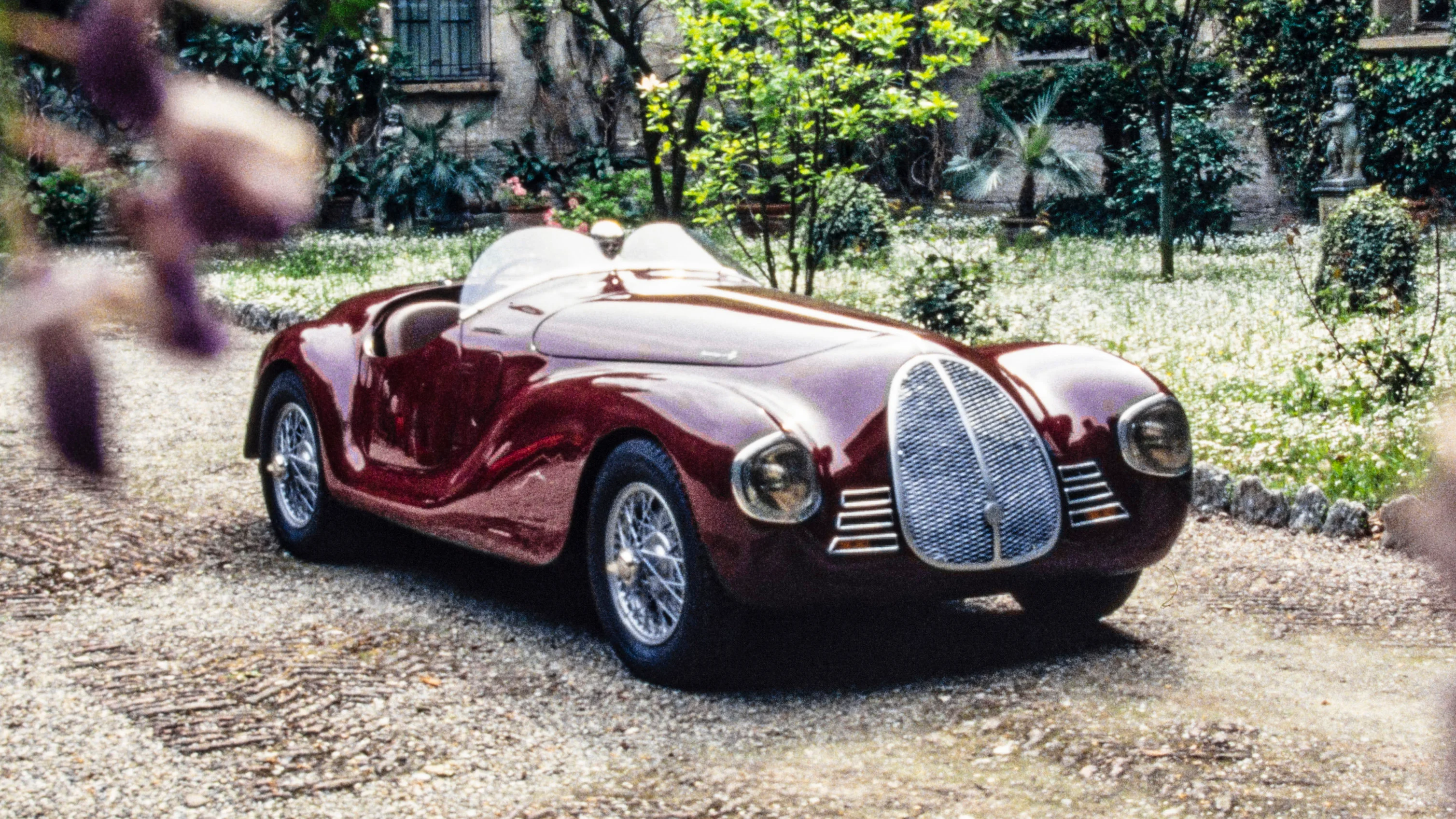
Alberto Ascari’s AAC 815 raced in the 1940 Mille Miglia.
Image credit: Getty Images
Both entered the 1940 Mille Miglia, they quickly renamed the Brescia Grand Prix because Mussolini had banned open road racing after the death of ten spectators while the Lancia Aprilia entered the crown in 1938. The race was held nine times closed 104-mile triangle course, giving two more points in Cremona and Mantua.
What is interesting is that both cars led the 1.5-liter class, more than the opposition based on Aprilia with clearly less difficulty. But both would retire with engine failure, Ascari at the start of the race, Rangoni far behind and leading the pack by many kilometres.
Enzo would dismiss the cars, saying that they were not successful because of the lack of development time and I have no doubt that he was completely money. Six weeks later, Mussolini invaded France, bringing Italy into the war on the wrong side of history, and it would be for a very long time.
However both cars survived the collision, but not – in the case of the Rangoni car – the apparently dangerous journey to the scrapper in the late 1950s. So one Ascari car remains, in a private collection, as the only reminder of what the first Ferrari was, even if it was not allowed to be described as such.
-
tribe
-
of history
-
Frankel’s insight
-
ferrari
-
enzo ferrari
-
ACC 815
-
A thousand miles
#real #Ferrari #GRR