Technical service center TV Skyline is also back in full force for the Deutsche Tourenwagen Masters (DTM), the German auto racing series sanctioned by the Allgemeiner Deutscher Automobil-Club (ADAC) that runs a modified version of the supercars of the GT3 class.
The opening round of the DTM 2026 season will take place at the Red Bull Ring in Spielberg, Austria, from April 24 to 26. This race is TV Skyline’s first as a broadcaster of the event since 2022, when the DTM was sold by its then owner, ITR, to ADAC, which had its OB provider under contract. That contract expired at the end of the DTM season and TV Skyline was awarded the host broadcast contract.
This time, TV Skyline brings multiple cameras, 1080p output, remote streaming functionality and more to the host’s DTM broadcast.
Addition of camera
Over eight races this season – six of them in Germany, as well as one in Austria and one in the Netherlands – TV Skyline uses the original camera and technical setup, based on 25 broadcast cameras to capture the track itself. However, each track is unique so additional cameras are used where necessary to ensure spectators don’t miss any of the action, including wireless cameras in the pit and in the paddock.
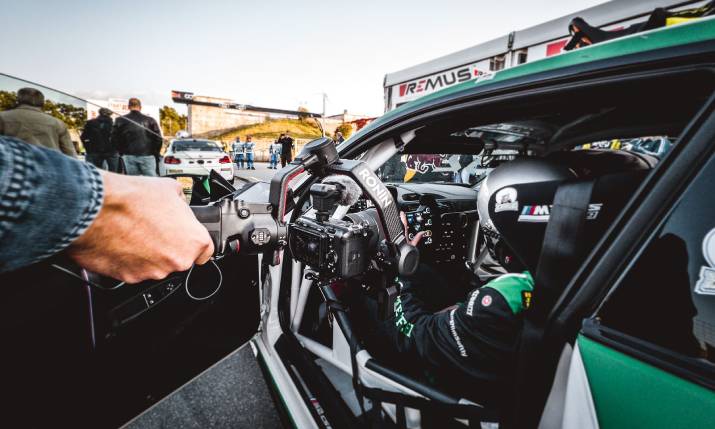
Julian Reeh, TV Skyline sales manager, says: “The wireless cameras, which are mostly down in the pit and in the paddock, where we have six cameras this year, are a little bit different. “One of those six cameras is a high-speed wireless camera, and what’s new this year is that we’ve converted two of the six wireless cameras into cinema cameras.”
He adds about the introduction of the cinema camera: “I think it is no longer a new way of using cinema – it is becoming more common in sports – but we also want to join this process to improve the images we receive, which we think will be good for the look and feel of the broadcast.”
Small cinematic cameras will be worn by the camera crew on the gimbal, which allows them to move with more power to approach the story and follow the details with more accuracy.
TV Skyline also uses its mechanical camera, which is a wireless body camera worn by one operator who is also the operator of one of the teams. It’s used during pit tire changes, where they can take interesting angles for hoist coverage, says Reeh.
“This was included in the DTM last year, and now we will continue to use it because the images you get are very powerful; you see like the POV of the mechanics, you see the car arrive, then you hold like a tire, you take the tire off the car, someone puts a new one, uses all the tools and so on, and then the car moves. The pictures are very good.”
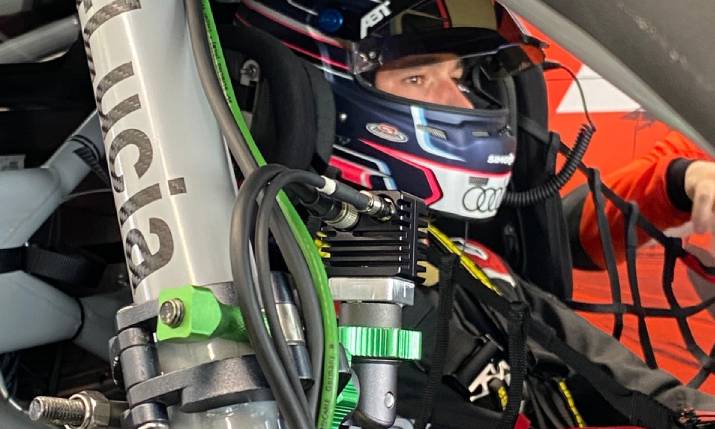
Another addition this year is the on-board cameras, which during this season will be expanded from eight live cameras at the start, to all cars with multiple dashboards available at the end of the season. The onboard cameras use the 5G network to transmit, and TV Skyline will explain more about the system and its partners for the new operation later in the year.
“We have cameras on board, which are new this year in the DTM,” says Reeh. At the beginning of this season in Spielberg we plan to have eight racing cars in the DTM with an onboard camera. Last year there were only six cameras. [on cars] and our goal for the season is – and let’s see if we can achieve it! – that in the final race, which will be held in October in Hockenheim, every race car in the DTM will have at least one camera, so we will have more than 20 cars and each one has a camera on board.
Technical trucks
The technical setup for the DTM uses half the number of trucks this year, as TV Skyline brings in the big guns in the form of its OB11 and G10 trucks. Reeh says: “Compared to last season we are doing the host broadcast more efficiently than it was done last year and the previous season. We are able to provide the same technical style with only half the number of trucks of the TV compound compared to last year. This is mainly due to the combination of OB11 and G10.”
He adds: “In general, DTM is a big production, technology-wise, but also with the staff, we need a lot of work spaces in the OB cars for different departments. We have three different galleries, for example. We have world food, we have balanced food, which is international food. EVS and replay operations etc. and that’s why in the past the OB broadcaster has which required bringing more OB trucks to the site to fit all the people inside.
“The good thing about our setup is because of the combination of our OB11 and G10, we can accommodate more people inside, but do it with only two trucks.”
Each truck is spacious, and the OB11 has no technical room inside; all the technical equipment, from switchers and such as mainframes for the visual mixer, is held in a simple truck.
Reeh adds: “The back of the light truck is a storage area for all the cameras and so on, and the front of the light truck is the engineering room where all the technical equipment works. The OB11 is connected by fiber cables to the light truck and this saves us space for the OB11 because like all the technical equipment is already inside the light truck. The second thing is that the G10 is not a connected truck, the G10 It is not a connected truck.
Modern design
DTM is also changing from 1080i to 1080p this year. Comment Reeh: “Well, we said we just want to go with the times. I think that presenting it in 1080i is not very modern, especially because of the conditions that DTM also streams many of their products and the streaming is also done in continuous time.
“For us there is almost no change. OBs can do both, so it’s almost like a click or change, and we do it with 3G. In details, it’s not easy because everyone involved now needs to adapt if, for example, they bring their images to production and so on.”
Parts of the DTM production stream are also being done remotely this season for the first time, based at the Skyline TV center in Mainz near Frankfurt.
“In the past, all the broadcasts were done on-site while the tour operators had all their technical equipment sitting like in the OB car or somewhere in the TV area,” says Reeh.
He adds that at the moment there is still a safe SNG car on the site, but that, “I think that soon we will remove the SNG and do only the flow, but at that time, let’s call it a hybrid, where we have both”.
Additionally, social media clippings have been removed from the site. Reeh says: “This was usually done on site and now it will be done remotely. What we are doing here is for broadcasting, we have all the signals in Mainz and we will transmit those signals to Hamburg. In Hamburg, the company that did the social media production in the past is sitting in their company headquarters and is no longer at the racetrack.”
Keeping these workers off-site saves the production money on travel and accommodation. “We’re looking at every department, every part of the DTM, to see if we can do something remotely, yes or no,” says Reeh.
The 2026 DTM season opener at the Red Bull Ring in Spielberg, Austria can be watched across Europe via ServusTV, the official DTM YouTube channel, and Red Bull TV. Motorvision TV provides important information.
#Modern #presentation #Skyline #takeover #Deutsche #Tourenwagen #Masters #racing #series #accelerates #future #SVG #Europe