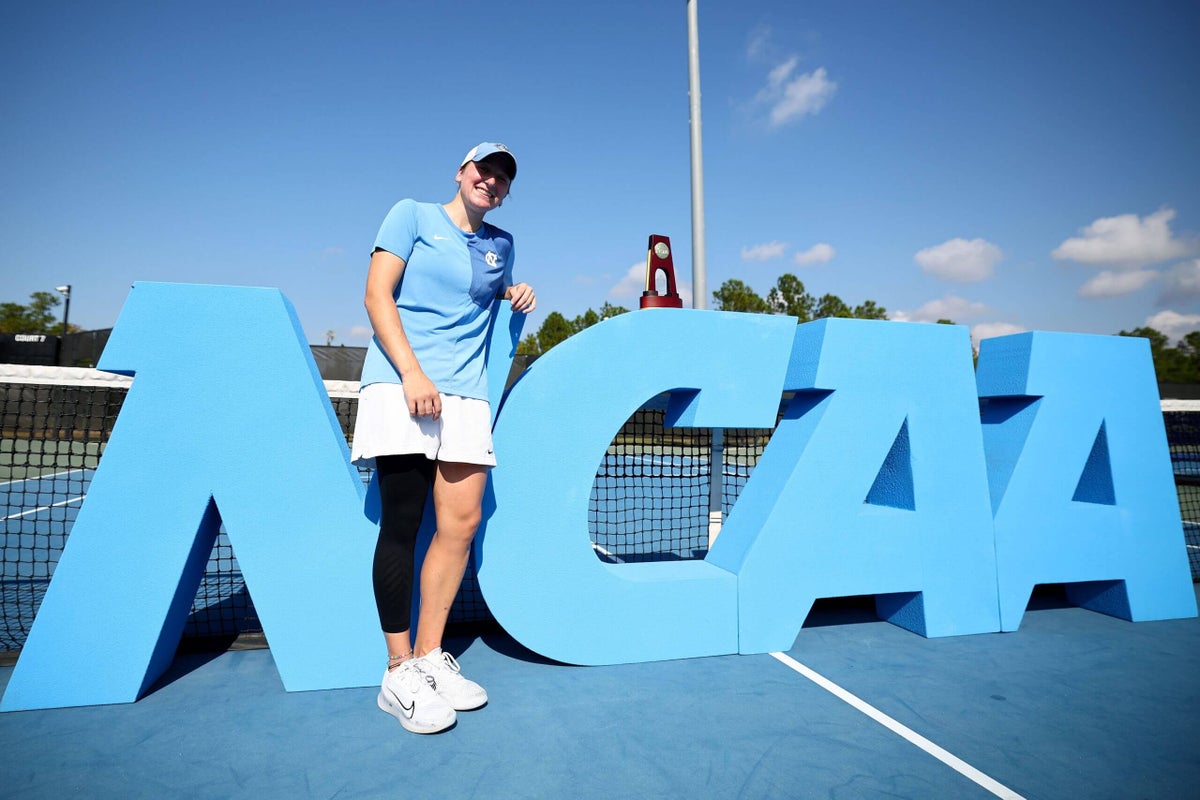
When Reese Brantmeier, the University of North Carolina’s women’s college tennis champion, decided two years ago to lead the team’s lawsuit against the NCAA, her goal was to help her fellow players save the money they could earn before and during their college careers.
A settlement is possible later this month, according to court documents and a source briefed on the case, who is not authorized to speak publicly about it before it is concluded. With it, Brantmeier and his co-plaintiff, Maya Joint, seem to have pushed the NCAA to change its rules for all sports in its most popular category.
On Wednesday, the Division I Cabinet, which governs the top level of college sports, approved a report on a series of rule changes. They include one that would allow prospects to receive all of the prize money earned in their various sports before enrolling in college.
Currently, prospects can only receive prize money up to actual and necessary expenses, except in tennis, which allows up to $10,000 in prize money. For pre-registration, any prize money above $10,000 must be used as an expense in the competition in which it was earned; after registration, the prize money is linked to the annual expenses.
According to a person briefed on the case, the settlement will eliminate restrictions on pre-registration income and create a $2 million fund for athletes who have been affected by the law in recent years, if they can prove they are eligible. This decision will allow tennis players who have lost their salary while registering from 2020 to apply for a refund.
“These proposed changes reflect the ongoing work of Division I members to update our rules to adapt to the current era of college sports,” Josh Whitman, chairman of the Division I Cabinet and director of athletics at the University of Illinois, said in a statement Wednesday.
“As the Division I membership continues to review all eligibility rules in the coming months, our goal will be to create a set of rules that can be applied equally to prospects and current student-athletes.”
That legal change is the main basis of the pending settlement of Brantmeier and Joint’s case, which Brantmeier filed in the US District Court of North Carolina in 2024. Joint, who represents Australia as a professional but grew up in Michigan and attended the University of Texas, joined as a named plaintiff last year. They will receive a $10,000 settlement as part of the settlement, and the NCAA will pay $1.85 million in legal fees and $425,000 in damages.
The law that prohibits athletes from receiving salary while in college will not change. Brantmeier, who initially sued after forfeiting most of his $50,000 in prize money from the 2021 US Open, wanted that rule changed as well. Joint became involved in the lawsuit after forfeiting most of the nearly $200,000 he earned from the 2024 Australian and US Opens before starting training. He has since left college to become a professional.
According to a source briefed on the case, the athletes and their lawyers may revisit the law in the future, possibly in another jurisdiction.
Critics of the salary cap rules have argued that it is hypocritical in an era when college athletes, especially football or basketball players, receive multi-million dollar contracts to compete for college teams, as well as corporate sponsorships.
As they stand, the most expensive college quarterback can receive millions to play on a college football team and show up at a car dealership to sign autographs, but college tennis players will not receive more than their cost if they qualify to play at Wimbledon, one of the four Grand Slams.
The exception is that college tennis players receive a salary cap in their final year of eligibility, since the process of calculating their expenses occurs once they leave college.
In this year’s Australian Open, Columbia senior Michael Zheng qualified and advanced to the second round, earning nearly $150,000. Zheng, a two-time NCAA champion who plans to graduate and turn professional this year, was allowed to keep his salary outside of that.
The rule change on pre-draft salaries is part of a package that includes a new rule that requires prospects to withdraw from professional leagues, including the NBA, if they ever choose to join. The package would also allow signing opportunities and agents to handle contract negotiations, whereas under current rules, they are allowed to do so for the sake of name, image and character.
There are narrow exceptions, which allow baseball and men’s hockey prospects to enter into contracts with agents if drafted by MLB or the NHL.
The Cabinet is expected to vote on the changes in mid-April.
Since the Brantmeier lawsuit was filed, college athletics has entered a new era of athlete compensation. The NCAA and major conferences, including the ACC, where North Carolina competes, entered into a $2.8 billion settlement last year. Chief among the settlement’s provisions: Schools are now allowed to pay athletes directly.
This, combined with the NCAA lifting the ban on athletes being paid for endorsements and sponsorship deals in 2021, has led to many college athletes – especially those in elite sports like football and basketball – earning hundreds of thousands of dollars a year.
College sports are more like professional sports than ever before.
But there are still old and outdated laws on the books. When the NCAA and conferences try to change the rules related to the compensation and eligibility of athletes, they have been faced with constant legal attacks and have been forced to defend many lawsuits.
That made the NCAA a smaller tie. Changing parts of the rulebook while protecting other parts in court can undermine legal arguments and provide advice that can lead to more litigation.
The NCAA has proceeded cautiously, but as the terms of the settlement are implemented, the member-run organization now appears to be taking serious steps to improve the rules of conduct it once staunchly defended.
#college #tennis #lawsuit #change #NCAAs #salary #rules