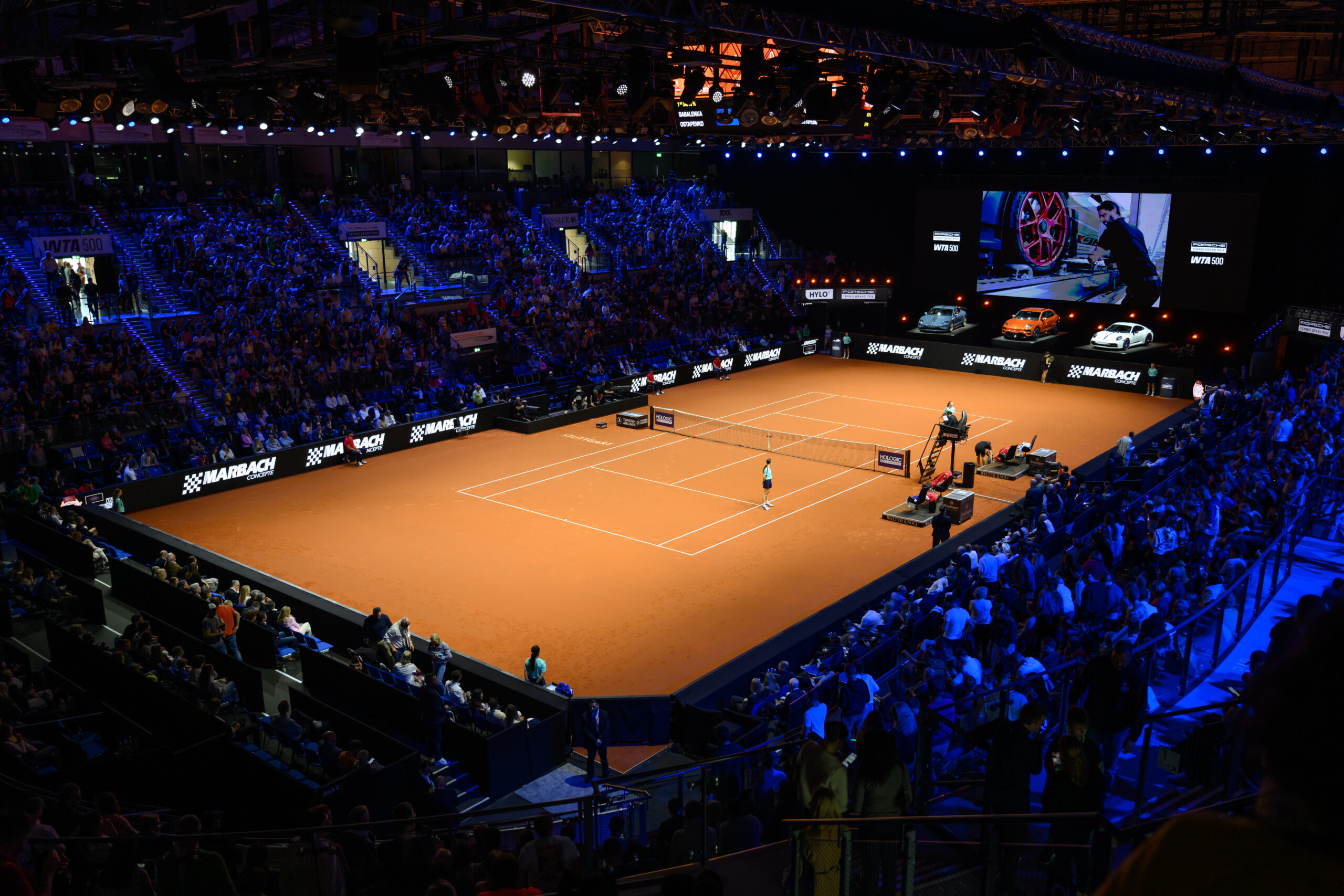
The third week of the Clay-Court swing brings the WTA Tour to Stuttgart for the WTA 500 Porsche Tennis Grand Prix.
And as the lead-up event to the recent WTA 1000 tournaments in Madrid and Rome, it provides a packed field as players look to form the heart of the clay season.
Played indoors at the Porsche-Arena, the Porsche Tennis Grand Prix began in 1978, although it was played on hard courts until 2008. Now the center of the Clay-Court swing, it continues to attract top players and serves as a barometer of who is ready on clay for the French Open.
Here’s everything you need to know about the upcoming Porsche Tennis Grand Prix, from key dates and key players to defending champions and prize money.
When does the tournament start and when will each round be played?
Qualifying action will begin on Saturday 11 April, with the first round starting on Monday 13 April.
The tournament will continue until Sunday, April 19, when the singles and doubles finals will be played. The singles final is scheduled to start at 1:00 pm local time, with the doubles final to follow.
Below is the daily schedule for singles and doubles play.
Schedule of singles
Eligibility: April 11th and April 12th
First step: April 13th, April 14th and April 15th
Step two: April 15th and April 16th
Finals: April 17th
Make the finals: April 18th
Conclusion: April 19th
Double schedule
First step: April 13th, April 14th and April 15th
Finals: April 15th and April 16th
Make the finals: April 18th
Conclusion: April 19th
How big is the solution, and who are the main players in the field?
Like the Upper Austria Ladies Linz last week, the Porsche Tennis Grand Prix offers a much smaller field of 28 players. (By comparison, the Credit One Charleston Open, which is also a WTA 500, had a field of 48 players.) The two draws will include 16 teams.
The field of 28 players includes 19 direct draws, four qualifiers, four wild cards and a special release. The top four seeds will advance to the second round.
The roster is stacked, and that makes a lot of sense considering the small field. Of the 28 players in the Stuttgart tournament, six are in the top 10 of the PIF WTA rankings and 12 are in the top 20.
Unfortunately, World No. 1 Aryna Sabalenka is not one of the players in the Top 10. A four-time finalist in Stuttgart, she was originally scheduled to play but had to withdraw due to injury.
World No. 2 Elena Rybakina is now in the headlines, and is joined by fellow top 5 players Coco Gauff and Iga Swiatek. All three Grand Slam players will be playing their 2026 matches on clay courts.
Elina Svitolina, Mirra Andreeva, Ekaterina Alexandrova, Linda Noskova and Karolina Muchova are also in the field.
Alexandra Eala is also on the main roster following the withdrawal of Emma Navarro and Qinwen Zheng.
Barbora Krejcikova, who has been out since mid-February, is scheduled to return to the Stuttgart tour.
The program will be revealed on Saturday, April 11. To view the full list of players, click here.
Wild cards: Laura Siegemund, Eva Lys, Ella Seidel, Noha Noha Akugue
Withdrawal: Aryna Sabalenka, Anna Kalinskaya, Qinwen Zheng, Emma Navarro
Basic additions: Alexandra Eala, Magdalena Frech
Who are the protectors of the warriors?
Jelena Ostapenko, who is also in this year’s field, is the defending singles champion in Stuttgart. World No. The 23-year-old had a dream last year, upsetting seventh-seeded Navarro and second-seeded Swiatek in three setters before knocking out Alexandrova in the semifinals. Then, in the final, she upset the top-seeded Sabalenka 6-4, 6-1, in one of the rare occasions in the last few years that the four-time Grand Slam champion looked out of sorts.
It was Ostapenko’s first win over Sabalenka in four tries – she had only taken one set in their previous three matches – and her first title on clay since winning Roland Garros eight years earlier.
Ostapenko was nearly flawless, winning 81 percent of her first points and allowing Sabalenka only 53 percent of hers. Ostapenko managed to earn 11 break points, converting six of them to gain control of the match. She has won eight of her last nine games, and Sabalenka has won just 10 points in the second set (which, in retrospect, seems incomprehensible considering how strong she has been over the past two years).
“Honestly, I didn’t tell anyone – I kept it to myself – but I felt very confident from the first day,” he told reporters after winning his ninth title. “I had, like, a weird — not weird — but in a good way, weird feeling. When I got here, I felt like something was going to happen this week. I felt really good to win this tournament.
“Because I think I’m improving every day and playing better. Yes, I think I deserve it.”
Past players in this year’s game include Rybakina (2024), Swiatek (2022 and 2023) and Siegemund (2017). 2018 champion Karolina Pliskova is another top player.
Gabriela Dabrowski and Erin Routliffe are the defending doubles champions. They beat Alexandrova and Zhang Shuai 6-3, 6-3 in last year’s final.
Neither Dabrowski nor Routliffe is in doubles this year, and Alexandrova is still playing singles. Zhang will play Ostapenko.
What factors and income are at stake?
There is $1,206,446 up for grabs for singles, the same purse awarded in Linz last week.
Here is a complete breakdown of the prize money and points at stake for the Porsche Tennis Grand Prix.
Champion: €161,310 (~$188,438) | 500 ranking points
Finals: €99,565 (~$116,309) | 325 ranking factors
Semifinalists: €57,395 (~$67,047) | 195 factor levels
Quarter finalists: €30,435 (~$35,553) | 108 factor levels
Step 16: €15,690 (~$18,329) | 60 rating points
Step 32: €11,309 (~$13,211) | 1 condition point
Doubles players will receive €53,510 — about $62,509 — and 500 ranking points.
#Stuttgart #Dates #top #players #draw #prize #money