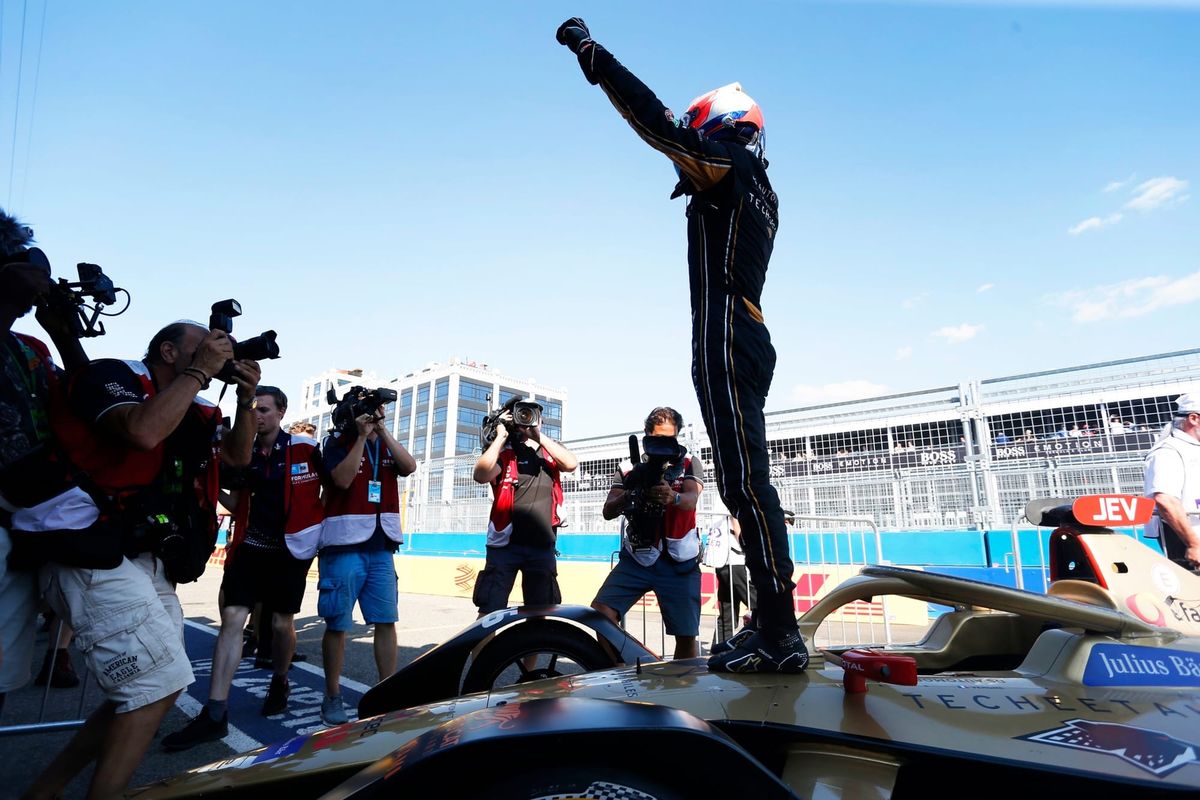
When the start-up manufacturer signed off on its exit from Formula E last month it did so as the most successful technical force – and more than likely it has the claim that it has achieved it all with limited resources amid direct opposition from the manufacturer.
DS Automobiles, through its sports arm, DS Performance, has been winning big in Formula E for almost a dozen years. Its history can be told by the statistics of four championship titles, 18 wins, 55 podiums and 26 pole positions, but what is more interesting is its culture and its status as a non-hero in the entire history of electricity.
In 2014, DS as a brand was relaunched and spun off from Citroen – ironically now its Formula E brand, 12 years on. An avant-garde riot that was given a sports platform by the owner of the time, PSA, ironically the first car inspired by the DS was actually the Formula E car of 2015, long before the DS road cars were available to the public.
It is clear that the program of choice had to be Formula E, which was launched in the fall of 2014. The DS plan was to enter the second season of 2015-16 when the increased freedom of electricity was intended to attract manufacturers. The idea worked as Renault and Audi also committed early, while BMW, Mercedes, Jaguar and Porsche soon followed suit.
Now, still at PSA’s headquarters in Satory, south of Paris, a small team of engineers began to design as the deal with Virgin Racing for the season approached.
There were short lead times, but under the control of the FIA’s technical director, Xavier Mestelan-Pinon, and with a technical team that included the Citroen World Touring Car Championship race and test team manager, Thomas Chevaucher, the speed of design, production and development quickly rose.
“I’ve never seen a brand that was so involved in the motoring program,” Chevaucher, who became Formula E project manager in 2015, tells The Race. “We had a very close relationship with the sign board, and it was really part of the strategy.”
In that first season, Sam Bird and Jean-Eric Vergne campaigned a twin-motor powertrain with positives and negatives that brought excitement and challenge in equal measure.
“The two-motor setup was strong in torque and handling but also heavy,” explains Chevaucher.
All this meant more creative solutions for the technical team and the drivers, especially in a race where the weight was often used by one machine, and therefore the lighter opponents.
“One of the biggest challenges of that first season was getting the tires in the window during qualifying, and that twin engine was heavy, but also very capable of high torque,” Chevaucher adds.
“That gave us, at the time, a good advantage in terms of putting the tires in the window. It worked very well in qualifying, not so well during the races, but we usually started in front.”
Indeed, it was. DS Virgin Racing took four positions throughout the season and the first of 18 was won in Buenos Aires by Bird. But it was the following season when the real success began, and it came after the first technical part of the DS program was completed.
The dual-motor design, which was originally a design solution, was changed to a single-motor, well-tuned unit for 2016-17 and that’s where things started for the DS. When Vergne left for the new Renault-powered Techeetah team, it was Bird who first showed how serious DS was in its Formula E program with a memorable win at the New York City E-Prix.
The following season, Bird was a real contender but fell short when former teammate Vergne took the first of his two. At that time, it was known that the DS would switch to Techeetah for the Gen2 era, in which the French manufacturer grew significantly in terms of equipment and ambitions.
“DS Performance was entering a new phase at the time,” says Chevaucher.
“They’ve invested a lot of resources, a lot of effort, and they’re working hard to improve that [Gen2] car. It all paid off, which was an amazing feeling for the band, and it was a huge payoff for the brand. We were starting a program of [road] cars at that time so the timing was right.”
Vergne’s second title came in the summer of 2019 after wins in Monaco, Sanya and Bern. DS Techeetah also won the team championship, making it four wins in two seasons.
But there was more when Antonio Felix da Costa’s 2019-20 victory added to a third consecutive series that, despite Mercedes EQ’s best efforts after several seasons, meant that DS Techeetah remains the most successful outfit in Formula E history.
The building blocks for that success came with the realization that DS had to grow and add resources to its lineup.
Later down the line, Stellantis Motorsport (Stellantis is a group with many car manufacturers including DS, Citroen, Maserati) and more cohesion was applied, with top technical expert Leo Thomas coming on board in a senior role at the end of 2022.
“We started building a motorsport team seriously to prepare for Porsche and Mercedes [joining Formula E] because it was a great opportunity for the name to compete with these names, as well as on the streets,” sums up Chevacuher.
These streets are said to be city streets when the DS electric range is revealed, but those words are supported by da Costa again with the final success of Gen2 in Monaco in 2021 and New York in 2022.
But it was all change for the Gen3 season a year later when da Costa moved to Porsche, Techeetah folded, and most of the staff went to Penske, where the DS arrived.
Gen3 has been very disappointing though with only three wins in three and a half seasons, one for Vergne in Hyderabad and two for Maximilian Guenther in Shanghai and Jeddah.
“Gen3, the car was becoming the ultimate race car, I would say,” says Chevaucher.
“Increasingly, all the producers were reaching the highest level, and the power system began to be well controlled. The situation was still professional throughout the network as well, so it was continuing to enter the details of everything.”
Some of those points were clearly missed by the DS in Gen3 but it was often a frontrunner, even if its winning record wasn’t as strong as it was in Gen1 and Gen2.
But off the track there was a different kind of success as DS combined its automotive and racing divisions with the DS E-Tense Performance, a high-performance electric car that serves as DS Automobiles’ ‘laboratory’. It used Formula E technology to achieve 804bhp and 0-100 km/h in two seconds.
“It was also kind of the link that was there with the model,” says Chevaucher. “It was all a very interesting part because we wanted to have an electric four-wheel drive vehicle in the Gen3 era.
“There was a kind of fit in everything, I think between DS and Formula E. Just that the story started together and we really felt part of the family. There was a great strength between DS and the competition.”
The three best DS hits
Buenos Aires 2016
In a heavy and generally untracked DS Virgin Gen1, Bird held off a charging Sebastien Buemi in his e.dams Renault-run car in a thrilling rally that had echoes of Gilles Villeneuve’s 1981 Spanish Grand Prix.
“We knew you were [Buemi] he had a clear operational advantage, and he started from behind,” says Chevaucher.
“We said, ‘Maybe we have a little chance’ but we really thought he was going to get us. We were just hoping Sam would do his magic. And he did.”
Punta del Este 2018
A battle as intense as Formula E has ever been, as Vergne held off Abt Audi driver Lucas di Grassi after a lap in the middle of the day and rode one of the most memorable tracks in Formula E history.
It put a clear signal to Vergne’s opposition that he was in a long-term battle and highlighted it with another victory in Paris and New York to take the first of his two crowns.
Monaco 2021
One of, if not the best E-Prix, as da Costa’s DS Techeetah went hammer-to-toe against Mitch Evans (Jaguar) and Robin Frijns (Envision Audi) in the first Formula E race at the right Monaco circuit.
Da Costa’s hair-raising – and ultimately winning – final move on Evans at the port chicane defied various laws of physics.
#outgoing #Formula #manufacturer #remains #influential