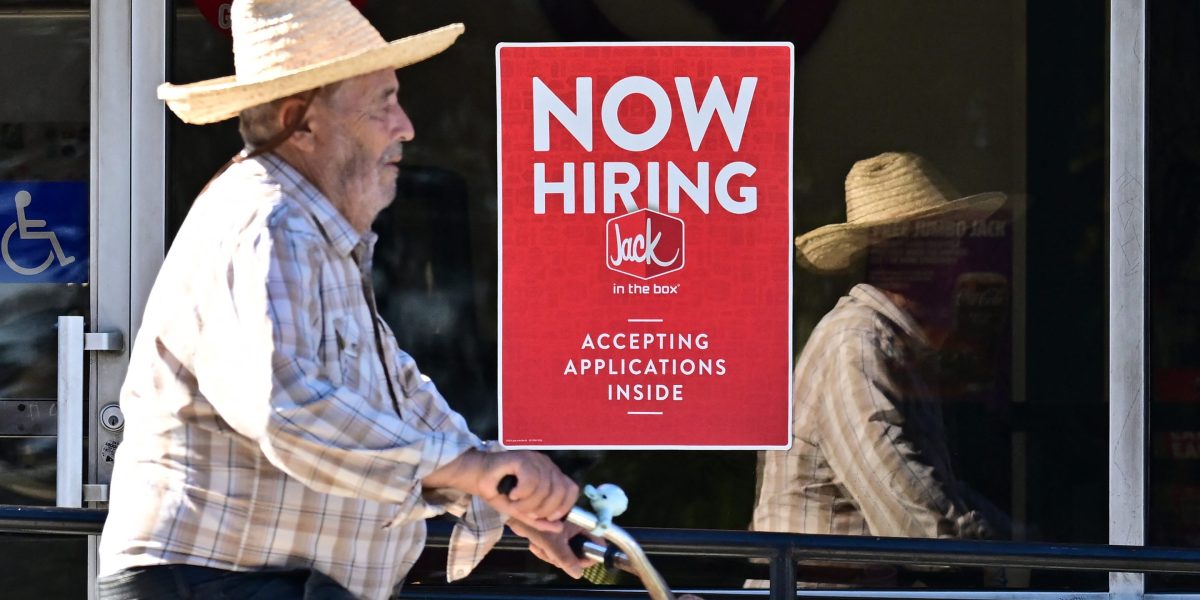
The Bureau of Labor Statistics reported Tuesday that the hiring rate fell to 3.1% in February, with just 4.8 million new hires, the lowest since April 2020. Job openings fell to 6.9 million, down 358,000 from January. The unemployment rate was lower at 1.9%, while the unemployment rate remained at 1.1%, and the number of people retiring fell near record lows. Everyone seems to be sitting around, either in jobs or out of a job.
“It’s a bad job market,” Heather Long, chief economist at Navy Federal Credit Union, said. Good luck. “Seeing the hiring rate at 3.1%, the lowest since April 2020, when the economy was closed during the COVID period – it just highlights how weak hiring is.”
The 2020 comparison is what makes this report amazing. Back then, hiring was down because businesses were closing. Today, unemployment is about 4% and businesses are open, but employers still aren’t bringing in anyone.
A ‘locked market’ for new hires
Nicole Bachaud, a labor economist at ZipRecruiter, wrote in a letter that it’s a “locked market” for new entrants, driven by stalled hiring and delayed retirements that are restricting the natural pipeline.
“Except for the 2020 dip, the employment rate has not fallen this much since 2014, when the labor market was rebuilding after the Great Recession,” he wrote.
He also said that part of the problem is caused by another major force: bad weather. Construction and accommodation/food services were the two industries where employment fell the most, and were the most affected by the weather. February marked a critical month across the country, with storms and hurricanes.
Skanda Amarnath, chief executive of Employ America, an economic strategy firm, said bad weather and health care explained part of February’s decline, but not all.
“We’d probably say 50% to 60% are just one type,” he said. Good luck. “But something important is also at play.”
He pointed to reduced immigration as one factor that is quietly draining power from the system: Less population growth means less attrition, fewer people changing jobs, and less hiring.
The length of time is a warning sign: Hospitality and construction are often the first destinations for displaced workers, not the areas most likely to be affected by economic headwinds.
He said: “A lot of people, when they lose their job, they think, ‘Okay, at least I can be a bartender or work in a restaurant.’ “And obviously there has been a decline in that area.”
How the war will affect jobs in America
The JOLTS (Job Openings and Labor Turnover Survey) data comes out in February, before the US-Israeli campaign against Iran raises global energy markets. With Brent crude hovering above $115 and the Strait of Hormuz effectively closed, the question is whether the low-income labor market balance can survive the energy shock. Bachaud warned that rising gas prices will affect transportation, manufacturing, sales and consumer spending – “it will reverse the hiring process in the March data.”
Long said the war could be the last straw on the camel’s back for the labor market.
“It doesn’t make sense for companies to let hiring start to shoot in order for their budgets to work,” he said, adding the April jobs report, due in May, “could be the first warning sign.”
For the Fed, the report deepens the potential for stagflation. Amarnath noted that inflation continues to be a full percentage point above the central bank’s primary target and in the wrong direction, even before the war.
He said: “The Fed has to watch out for the dangers that their policy is not really tight enough.”
The March jobs report, due Friday, will provide the next report on the labor market. Both economists have cautioned against drawing too much of a straight line from JOLTS to wages, but the broader picture remains difficult to decipher. Long said if Friday delivers another weak number, “it looks like some of the early news is back in the picture.”
#Hiring #hit #unprecedented #levels #economy #virtually #shut #COVID #top #economist #Good #luck