There was a moment at Wimbledon last July that felt like it might define the career in the sweetest way. Grigor Dimitrov, 34, made Jannik Sinner two seats in the Center Court. The world number one, who hadn’t won a match in two whole weeks, suddenly roared. The crowd was electric.
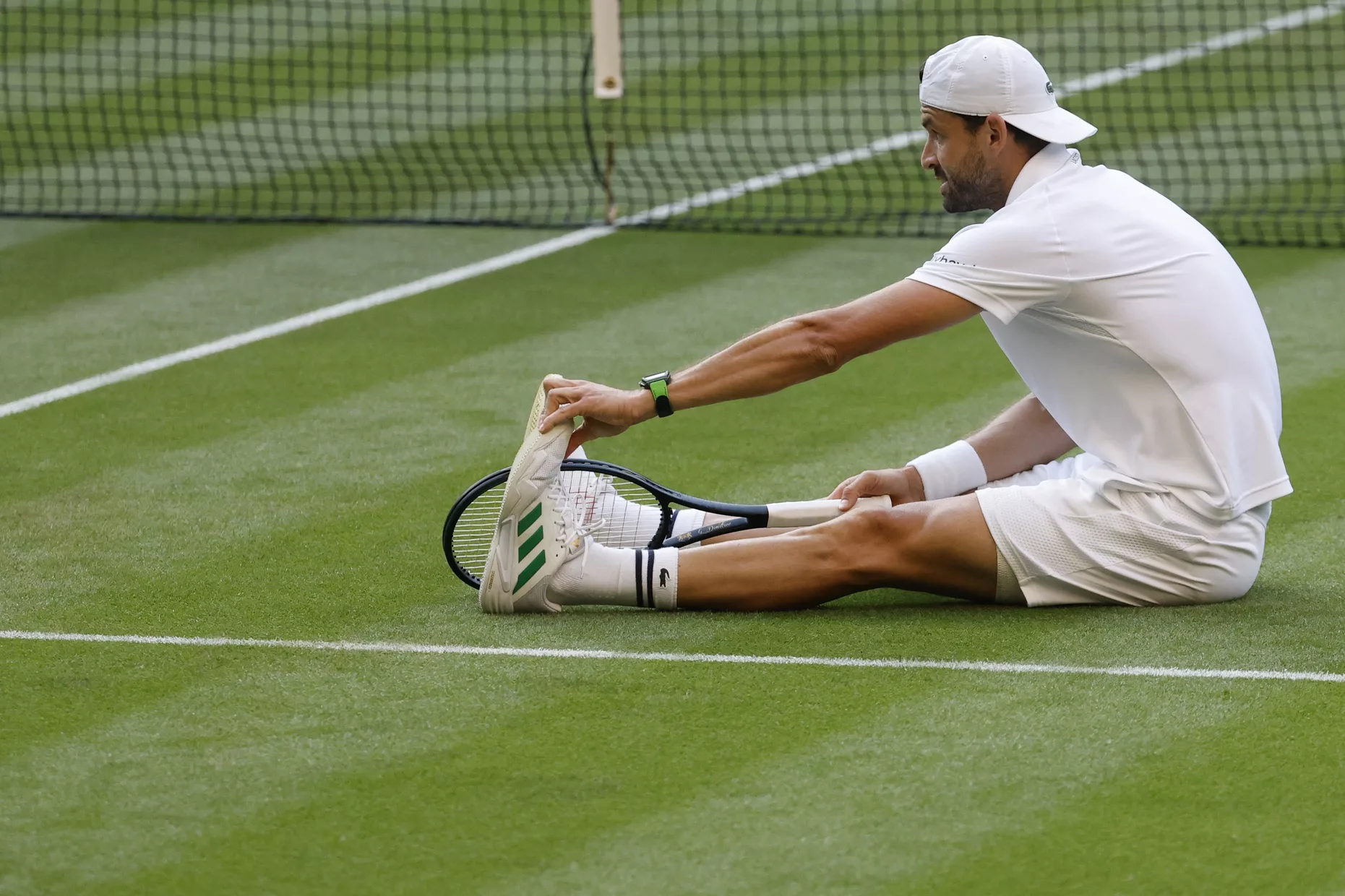
And, while serving at 2-2 in the third set, Dimitrov fell to the ground clutching his right hamstring and began to cry. It was his fifth consecutive Grand Slam retirement. The sinner crossed the net to look at him, then carried his bags from the court. The image of the naturally gifted tennis player of his time being helped off the court he should have won is hard to shake.
On Tuesday, Dimitrov lost in the first round of Monte-Carlo to world number 30 Tomas Etcheverry. He now holds a 2-7 record in 2026 and has lost seven of his last eight games. He will drop to number 135 in the world, his lowest ranking since October 2010, when he was 19 years old and nobody had heard of him. The last time he was outside the top 100 was March 2012. The question that no one in particular wants to ask, but everyone who thinks about, cannot avoid: is it over?
What does Grigor Dimitrov leave behind?
The Evidence Against Him is convincing
What makes Dimitrov’s current situation so terrifying is not one result, but the accumulation of damage over the past two years. In 2024 she retired at Wimbledon with a leg injury, and retired again in the US Open quarterfinals against Frances Tiafoe. The 2025 season brought first-round retirements at the Australian Open and Roland Garros before a tear against Sinner made it five consecutive Grand Slam titles. A chest injury eventually ended his streak of 58 consecutive Grand Slam matches, a streak that began at the 2011 Australian Open. That race had long careers. He had been a perennial fixture in the big leagues for 14 years, and it was over.
Physical decline is accompanied by steady decline even by the standards of the decline of the ancients. Dimitrov started 2025 as world number 10 and was still a top 20 player as recently as July. He’s now heading for 135. A drop means he’s out of the main draw at Roland Garros, and entries close immediately, meaning he’ll need a wild card to compete at the French Open. The 2017 ATP Finals winner, Grand Slam semi-finalist, briefly and surprisingly ranked third in the world, is now in line for wildcards in a tournament he has played as a seed for the better part of a decade. It’s a difficult thing to write.
There is also the question of whether the body will no longer be able to support the demands of the trip. The Wimbledon tear was Dimitrov’s fifth consecutive retirement, a streak that stretches from Wimbledon 2024 to Wimbledon 2025, covering groin injuries, leg injuries, abductor tears and a torn pec. These are not soft tissues that need to be managed between games. They are major structural accidents that each required weeks or months from the trip. At 34 years old, with a body that has been competing at elite levels since his youth, recovery windows are getting harder to navigate. However, the gaps between accidents are not increasing.
The subject of yet another Chapter
The debate, and it’s real, starts with what Dimitrov did when he was healthy. Even in this most destructive period of his career, the talent has not disappeared. The Wimbledon match against Sinner was no match for a diminished player. It was a near-perfect performance, smashing the world number one in two sets with the kind of all-court tennis that earned him the nickname Baby Federer in the first place. That the game ended in a hospital bed rather than a trophy ceremony is a tragedy, not a downfall.
He has also completely revamped his coaching staff, bringing in Xavier Malisse at the start of 2026 and adding world number three David Nalbandian ahead of Acapulco, replacing the long-term replacement he had in his prime. Sound like retirement? Not really.
It is also important to note that Dimitrov has never had. For all his talent, he never won a Grand Slam. He has yet to make it to one of the big four. A rare paradox of his career is that the ceiling he showed was always higher than the ceiling he reached, and the reasons were rarely about ability. It was about timing, about places that weren’t right for him at the right time, and more about his body not cooperating. A player driven by that kind of unfinished business does not stand idly by.
The honest answer to the main question is: maybe it wasn’t done, But it is possible that it ended up being a real force at the top of the game. The way back to the top 50 from 135, to 34, after two years of serious injuries, playing in the tour controlled by Sinner and Alcaraz at the beginning of their physical peaks, is not easy to map. It would require a sustained period of good health that nothing on the recent record indicates will come. The wildcards and qualifiers that await him soon humble the player of his lineage, and the points needed to return to true significance are important.
But Dimitrov has always been the kind of player that makes you want to believe. That hasn’t changed. What has changed is the margin of error, and for a man whose body now seems to betray him at the worst of times, that margin remains infinitely thin.
Original photo credit: Images by Geoff Burke-Imagn
#Grigor #Dimitrov #finished